
There’s a common theme threaded through some of the most useful and practical products used in everyday life – innovation, curiosity and a desire to simplify complicated ideas. For Apollo Entertainment founder Duncan MacMillan, innovation often starts with a simple question: why doesn’t it work like this?
From TVs and satellite systems to lithium batteries, caravan levelling and waterless toilets, his knack for spotting opportunities – then finding the right people to turn ideas into reality – has helped shape products used by RV owners across New Zealand and beyond.
Spend an hour with Duncan MacMillan and there’s a reasonable chance you’ll leave with a new business idea. Possibly several. At any given moment, the Apollo Entertainment founder admits there are multiple conversations taking place inside his head.
“I’m having six conversations with myself at the same time right now,” he says.
It’s delivered with a laugh, but it goes some way to explain the constant stream of ideas that has driven Apollo since Duncan and his wife Helen founded the company in 2009.
Some ideas are fleeting. Others end up researched, tested and developed into products used in motorhomes, caravans and boats throughout New Zealand.
Duncan doesn’t claim to be an engineer, a tooling specialist or software developer. His particular skill is seeing an opportunity and refining sometimes complicated ideas into simple solutions.
“I come up with a concept, and then I find the right people to make what I want,” he explains. “I’m not necessarily a guy who can do everything. But I know how to find the right people.”
It’s a deceptively simple formula – and one that has served Apollo remarkably well.
Wired to solve problems
Growing up in Whanganui, Duncan left school and joined the Royal New Zealand Navy at 17, spending eight years in the service before moving into marine electronics.
Those early years gave him a firm grounding in radar, communications and navigation systems at a time when technology demanded hands-on thinking.
“They were the days when you had to use your brain,” Duncan says.
It suited him. After leaving the Navy, he moved into marine electronics, learning radar, GPS, sonar, communications and electrical systems. More importantly, he learnt to look at technology from the user’s perspective. That mindset remains central to Apollo today.
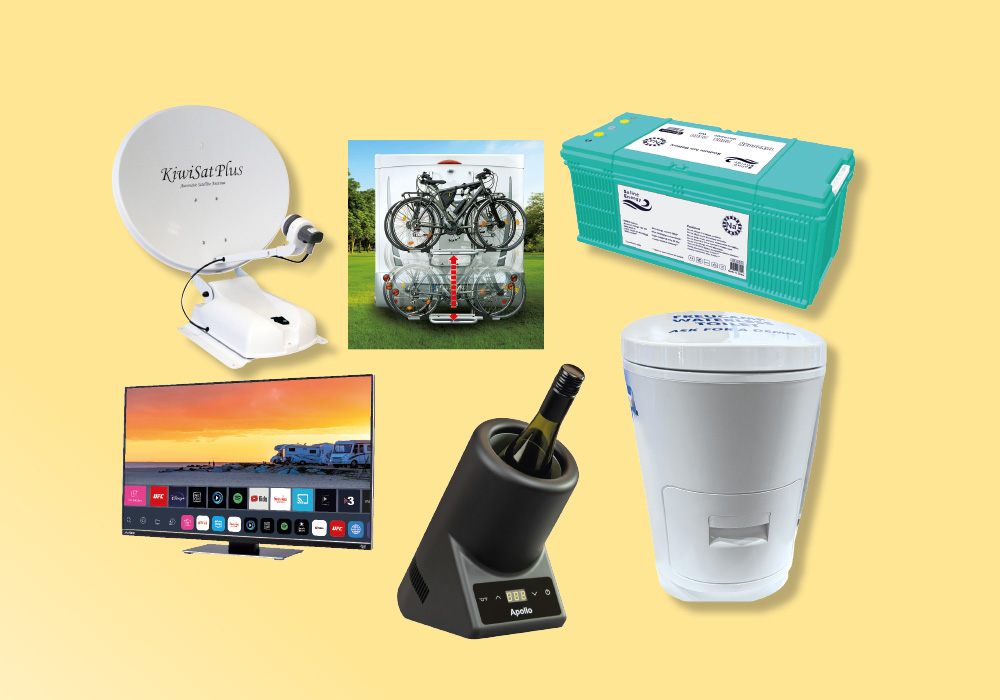
“We have to make things that are cool, but easy to use,” he says. Apollo’s KiwiSat satellite system, for example, requires the user to hold one button for four seconds to turn it on. Hold the same button again and it turns off. That’s it.
“We don’t want multiple buttons that people get confused with. What we’re making for the future has to be super simple.”
From an idea to Apollo

Apollo Entertainment began in 2009 with televisions. When the opportunity came to start his own business, Duncan wasted little time.
“I quit what I was doing and started this the next day,” he says.
Trade shows in China and Singapore followed and, within three months, Apollo had launched its own television.
The TVs sold well, relationships with RV dealers grew and customers soon began asking for another product: satellite dishes.
It was the beginning of a pattern that would repeat itself throughout Apollo’s history. Duncan spots something, asks a question and sees how it might work better.
During one meeting in Wales, he was shown a new soundbar. Duncan picked it up, turned it upside down and noticed it sounded better.
“I said, ‘It sounds better upside down’.”
The subsequent version was produced with the speakers repositioned.
“Just little things like that,” he says.
Except those ‘little things’ are often the difference between accepting a product as it is and seeing what it could be.
Kiwi thinking, international expertise
KiwiSat is one of the clearest examples of Duncan’s approach. Introduced to sophisticated Italian satellite technology, Duncan recognised the system was far more complicated than most New Zealand RV owners required.
European systems might need to find multiple satellites. In New Zealand, users generally needed one.
“We didn’t need all that flash stuff in it,” Duncan says.
So, he flew to Italy and worked with the manufacturer to create a system specifically suited to the New Zealand market. The result: KiwiSat was born.
Since launching in 2012, Apollo has sold around 30,000 satellite dishes.
The same Italian relationship introduced Duncan to Ma-Ve hydraulic levelling systems. Initially, he thought Apollo might sell six a year.
Some months, it now sells 12, with close to 1000 Ma-Ve systems in the New Zealand market.
Powering innovation
As RV owners became increasingly focused on off-grid capability, power storage was an obvious area for development.
The result of this is the new Saline Energy brand of Sodium Ion batteries, a new and exciting technology for the battery market.
Designed as a straightforward plug-and-play solution for the New Zealand RV and marine industries, Saline Energy batteries feature an integrated battery management system and Bluetooth app monitoring.
Lightweight and long-lasting, they can offer a lifespan up to five times greater than a standard AGM battery.
But, like many Apollo products, the range hasn’t remained static. New capacities and specifications have been added in response to what customers are asking for.
It’s not just about selling a battery, either. The Apollo team works with customers to develop complete power solutions, incorporating solar panels, controllers, inverters and charging systems.
It’s another example of Duncan’s preference for solving the whole problem rather than simply supplying a box.
Making ideas happen
Ask Duncan how many Apollo products he has conceived and helped bring to fruition and the number is around 15 – just off the top of his head.
Reversing cameras are another example. Apollo was already selling cameras when Duncan decided the product could be better. He found a factory, visited it and spent two days understanding its testing processes.
As volumes grew, Apollo refined brackets, antennas and colours to better suit RV installations. The company was also among the first to bring digital wireless reversing cameras to the local market, eliminating much of the interference associated with older analogue systems.
“I can work things out,” Duncan says simply.
Yet he’s equally clear about what he can’t do.
“I can’t write software. But I can find people who can write software. I don’t have an engineering background, but I can find people who can do the strengths and weights and all that stuff.”
Knowing your limitations, it seems, can be every bit as useful as knowing your strengths.
What’s next?
Caravan levelling has been simmering in Duncan’s mind for years.
Existing automatic systems were available but often came with substantial price tags or weren’t ideally suited to the variety of caravans in the New Zealand market. So, Duncan began working on another solution.
Apollo’s electric caravan levelling system uses actuators rather than hydraulic jacks, with four different leg heights designed to suit everything from lower touring caravans to larger Australian off-road models.
Once again, simplicity is key. The remote has three commands: up, down and stop.
“Make it idiot-proof,” Duncan says.
Also new for 2026 is the Freucamp Waterless Toilet, another product that fits neatly with Duncan’s preference for simple solutions to everyday problems.
Requiring no water, chemicals, ventilation system or external disposal hatch, each use is sealed inside an airtight, leakproof liner for disposal in general waste. No cassette too empty. No spills. No lingering odours.
“It’s always a clean toilet,” Duncan says.
Its compact swivelling design makes it well suited to RV bathrooms, while an optional rechargeable lithium battery allows independent off-grid use.
Most people might see a caravan toilet. Duncan sees wider use for this, in everything from boats, horse trucks and construction sites to orchards and farm buildings.
“The possibilities are endless.”
It’s all about the team
For all the ideas and product development behind Apollo, Duncan is quick to shift credit towards the people around him.
“The teamwork thing goes all the way back to the Navy,” he says. “It’s always about the team.”
Apollo proudly has a nine-strong team spanning workshop, administration, service and sales, with Helen an integral part of both the family and business. She perhaps sums up Duncan’s particular talent best.
“He comes up with ideas and starts the ball rolling,” she says. “Then people pick it up and things get done. And finished.”
Duncan doesn’t disagree.
“We’re in the role of the puppeteer now. Making things happen.”
What will he think of next?
Away from work, the projects don’t necessarily stop.
Duncan once spent two years researching how to build a pizza oven before constructing his own. He makes mozzarella and pasta sauce, owns an electric pasta machine bought in Italy and has been known to make four kilograms of fresh pasta at a time. His pizza dough takes three days.
“I do like doing stuff,” he says.
It’s easy to see the same pattern. An idea – research. A project – a finished result.
Recently, while talking with an electric bike rack manufacturer, Duncan suggested integrating charging points into the rack so e-bikes could charge while the RV was travelling. No one had done it. The idea is now being discussed further.
“It’s so obvious when you say it,” Duncan says. Perhaps. But someone still has to think of it.
After more than 15 years of Apollo Entertainment, Duncan MacMillan is still asking the same question: Why doesn’t it work like this?
Chances are, he’s already thinking about the answer.