

What will the motorhome and caravan of tomorrow look like? Our UK correspondent John Rawlings went looking for answers at Europe’s biggest RV show, where the latest innovations, clever concepts and emerging trends offered a fascinating glimpse of where the RV lifestyle is heading.
With 259,000 visitors and 834 exhibitors from 41 countries, the Caravan Salon Düsseldorf 2026 can rightly claim, once again, that it’s definitely the biggest show of its kind in Europe and probably the world.
If you’re planning a trip to Europe in late August or early September, I’d definitely recommend swinging into Germany to experience this magnificent show – but make sure you have comfortable walking shoes as there are 15 exhibition halls plus outdoor displays.
You’ll need more than one day to see it all. Fortunately, it has camping available on site which is also on a large scale and part of the experience.
As you can imagine, there is a huge amount to see. This year’s highlights included electric campers, interesting concepts, 4×4 adventure wagons, and even a campervan with a roof terrace.
The future is electric
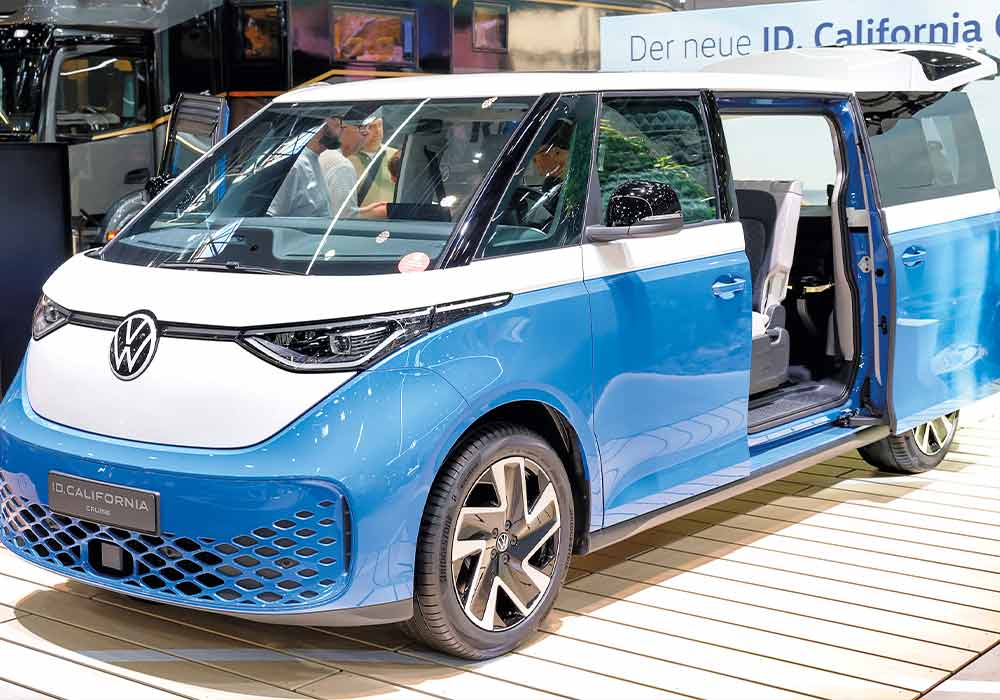
My expectations of Volkswagen’s ID. California Cruise – a camper version of its retro-looking ID. Buzz, was dampened when I saw it didn’t have a pop-top roof – or a kitchen. But you can sleep in it thanks to a mattress that folds out over the rear seats, plus it has an outside table and camping chairs. Stay tuned for more electric ID. California models due in 2028 (so expect them to be revealed at Düsseldorf next year). Keep your fingers crossed they include the classic elevating roof.
Instead, it looks like the KIA PV5 van/people carrier could take the lead in electric campers. Reimo, the brand that has been designing parts for campervans for decades, had its new EasyFit pop-up roof for the KIA PV5 on display, which should make it easier for many companies to convert this interesting new entrant to the leisure vehicle market.
More exciting still was the electric A-class motorhome EVOLVE concept by Vöhringer, developed with CityFreighter. It’s been developed on a purpose-built electric ‘skateboard’ platform to show what is possible when a motorhome in no longer constrained by a commercial van chassis. This gives the interior designers more room to play with.

With a 125kWh battery, a lightweight interior with full kitchen and bathroom, plus a heat pump and all onboard appliances, it weighs less than 3.5 tonnes. Remember that in Europe, there’s a special 4.35 tonne driving licence limit for electric vehicles. We don’t know if or when this will go into production, but I’m assuming and hoping they haven’t invested all their time and money for nothing.
For those towing with an electric car, the new Karoo caravan, made in Finland, is interesting. To reduce the impact on the range of an EV, its attractive shape is aerodynamic and lightweight. A rather compact interior includes a small washroom and kitchen at the front plus a small seating area at the rear. It’s not quite the height of a full-size tourer but might be OK for those under six feet tall.
Creating more space
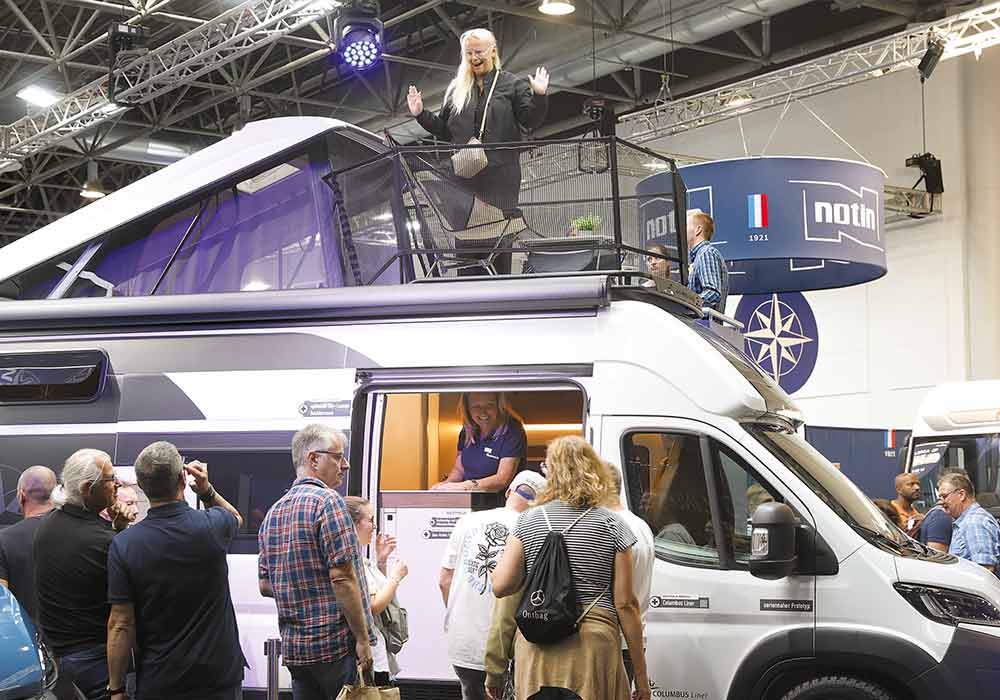
Also thinking outside the box, literally, were Westfalia campervans and Bauer caravans.
Bauer, known globally for its expandable X4 caravan, launched a bigger, X6 version at the show that almost doubles in size from 2.15m to 3.6m wide. That could create space issues on some campsite pitches, but the positives are that it creates space for two separate bedrooms and a fold-out terrace from the lounge. Its boxy compared to the cute and curvy X4 model, but equally innovative.
While Bauer created extra space by expanding the width of the trailer, Westfalia has looked upwards. Its new Columbus Liner campervan has an optional Sky Lounge with a roof terrace accessed from a pop-up roof above the rear bed. You could certainly look down on your neighbours from there and you’d have no problems cleaning the roof.
Attention grabbing

That wasn’t the only attraction grabbing the public’s attention on the Westfalia stand. It was also celebrating 50 years of its Sven Hedin model with an anniversary model inspired by its origins in the mid-seventies. It looked very retro with its two-tone brown stripes the length of its Light Ivory paintwork (also available in Pure Grey and Grey White) and brown interior upholstery. Despite the retro styling, it has all the mod cons you’d expect in a premium campervan. Definitely a cool campervan in my book.
Striking red, white and blue graphics made the Mega Re-Aktiv 700 Max Special Edition from Megamobil hard to miss. This style of 4×4 camper seems very in vogue at the moment, mostly offered on the Mercedes Sprinter. This one had extra equipment such as a roof tent, winch, underbody protection, air suspension and off-road tyres for €239,000. And in case you were wondering, the colourful exterior wrap represents the colours of Megamobil’s homeland – Slovenia.

I love seeing concept vehicles at shows and once again, Dethleffs had something of interest at Düsseldorf. Initially, the Dethleffs c.core motorhome concept looked quite conventional until you notice its ‘solar flower’ – an array of solar panels that extend from the roof like an awning to create shade while generating up to 600 watts of power for extended off-grid camping.
Dethleffs described the c.core concept as a ‘field of experimentation’ for new ideas, technologies and materials. Part of its Destination Future study, this included a beautiful interior in muted colours, weight-saving bonded aluminium exterior panels, recycled insulation materials, a water recycling system and – unusual in Europe – an outdoor kitchen.
Less positive, in my humble opinion, was the new look for Pilote’s 2027 A-class models. It’s a personal thing, but I just didn’t find the new angular design of the front panel very attractive. I’m sure others will love it and the statement it makes.

Finally, there was a campervan from Rapido that looked like every other Fiat Ducato conversion yet achieved star status at the show because of its interior.
Rapido had put its thinking cap on to come up with a genuinely new layout (the V64) featuring a longitudinal island bed at the rear. Open the sliding side door and you are presented with the two-seater bench seat where you’d usually expect to see the kitchen and the kitchen where the seats usually are. Clever! Apparently, it’s aimed at people downsizing from a motorhome who don’t want the usual transverse bed at the rear or two singles.
It’s hard to compress the whole of the Caravan Salon into a couple of pages, but I hope I’ve given a good flavour of the highlights. The show never disappoints and presented its usual mix of new models and future concepts, plus a lot more.
It is going to be really interesting to see how soon the supply of electric campervans grows. There’s already been a conversion of the KIA PV5 launched in the UK and I’ll report on that in the next issue with the highlights of our big autumn event, The Motorhome and Caravan Show.