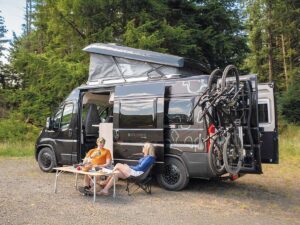

When it comes to adventuring by caravan, finding the perfect setup evolves as you discover your preferences. After eight years of fulltime RV life, ex-pat Brits Tom and Jordan Tasman have taken the lessons learned from five different vans and caravans to create their ultimate rig.
The pair have visited more than 25 countries together and clocked up 125,000km in Australia alone, touring in their first campervan, a Ford Transit named Muriel. Since landing in New Zealand in 2020, they’ve committed to full time travel, living and working from their home on wheels.
Tom and Jord have finally designed and customised their ideal caravan in partnership with Australis Caravans, and share their journey below.
When we first hit the road, we thought we knew exactly what we’d need in a van. Storage? Tick. A mattress? Tick. A fridge? Tick. Easy, right? But the truth is, you don’t know what you really need until you’ve lived it day in, day out, year after year.
Every rig we’ve owned has been a teacher in its own way. Some things drove us absolutely mad, some we loved, and others we swore we’d never do again.
Eight years and five rigs later, we finally got the chance to build something that’s truly ours. Our Australis 21ft High Country Xtreme isn’t just another caravan, it’s the sum of all those lessons. It won’t be perfect for everyone, but it’s perfect for us. And that’s the magic of going custom: creating a rig that fits your life instead of settling for one in the glossy brochure.
Building from the ground up

One of the biggest lessons we’ve learned is that what’s underneath matters just as much as what’s on top. Suspension, tyres, hitches; if those aren’t right, you feel it every single day, and usually not in a good way.
In our earlier vans, we spent far too much time chasing level ground. Every stop turned into a balancing act with ramps under the wheels, endless back-and-forth, and the inevitable “just a little bit more” conversation.
This time, we invested in the Cruisemaster Level 4 XT Air Suspension, and it’s a game-changer. The system takes care of the levelling for us, automatically adjusting when we pull in somewhere new. No faffing about, no crouching in the mud, no arguments; it just sorts itself out. That might sound like a small thing, but when you’re on the road for weeks or months, it completely changes the rhythm of your day. We roll in, press a button, and get on with enjoying where we are.
The Cruisemaster system also delivers a noticeably better towing experience by combining stability, comfort, and durability. Its independent suspension allows each wheel to move separately, reducing sway and giving better control over uneven or corrugated roads. Adjustable airbags let you fine-tune ride height to suit different loads and level your van on uneven ground, keeping towing smooth and predictable. The air system also absorbs shocks and vibrations far more effectively than traditional springs, resulting in a softer ride and less wear on both caravan and tow vehicle.
The truss chassis with its flat floor is another upgrade born straight out of experience. We’ve run out of storage in nearly every rig we’ve owned. We’re not the lightest packers, and between camera kit, outdoor gear, and all the everyday bits of life, space vanishes fast. The flat floor design gives us more usable storage.
We’ve also learned to appreciate the details that make setup easier. The BOS jockey unit and stabiliser legs are brilliant – tough enough to handle serious loads but powered with nothing more than a cordless drill. If we need to change a tyre, the stabilisers can even lift the wheels clear of the ground.
And then there are the tyres. We’ve shredded enough over the years to know better than to cut corners here. The BF Goodrich all-terrains give us the confidence to follow gravel roads or push a little further off the beaten track, knowing the caravan is just as capable as the tow vehicle.
Outside
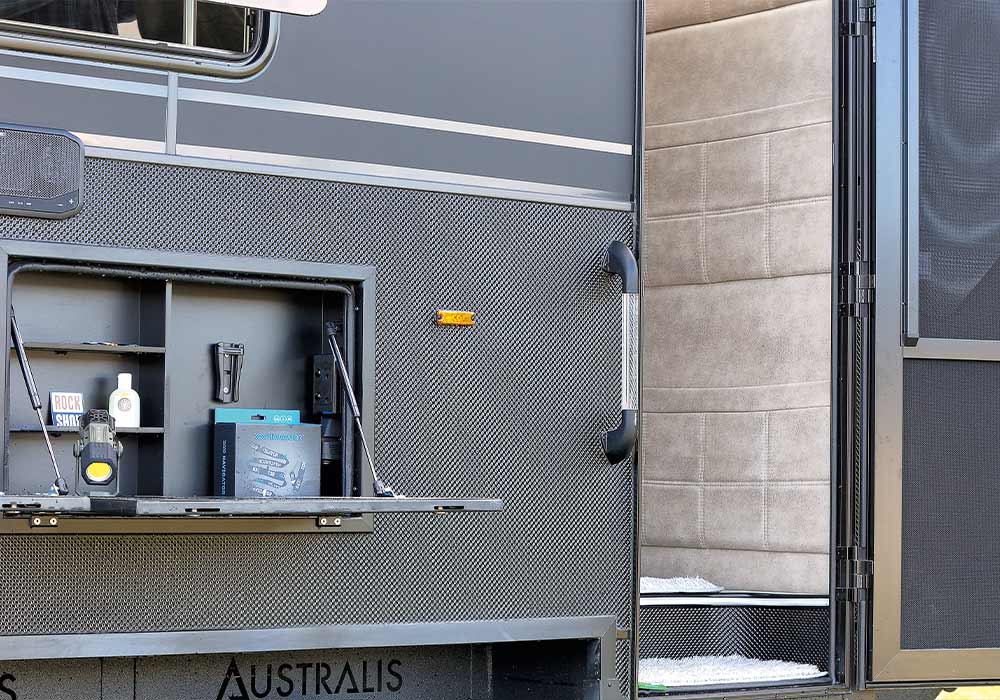
We spend just as much time outside the van as inside it, so the exterior setup has to work just as hard.
We added a Carefree electric awning, not just for shade but for simplicity, one button and you’re done. Fold-down picnic tables double as storage, and we even tucked in a pull-out Vendline washing line because we were sick of stringing rope between trees.
Storage outside was a big one for us. We’ve always had too many bits, hoses, chairs, tools, without proper places to put them. The monster toolbox up front and the full-width rear storage box are lifesavers. It’s not glamorous, but when everything has a home, setting up camp doesn’t feel like a chore.
And then there’s the look. We went for a fully blacked-out exterior, with our own decal designs brought to life by Paul and Linda Kircher at Signs On Time. Paul is a true master of his craft, endlessly patient, incredibly knowledgeable, and brilliant at turning ideas into reality. A ceramic coating by Fred Gordon at Alien Detailing protects the van from the elements; Fred is forward-thinking, excited by new challenges, and clearly thrives on projects both small and big, ambitious like ours. Both teams worked seamlessly with us and the crew at Australis Caravans NZ to create something exceptional. It’s tough, unique, and undeniably ours. That stealthy finish gets comments everywhere we go.
Decent camping gear has also become non-negotiable. We were fed up with buying cheap tables and chairs that bent, broke, or just didn’t last. Navigator Gear changed that for us, with a huge range of really solid gear that not only works but actually looks the part too.
Creating space that feels like home

After years of living in spaces that felt dark and cramped, we wanted this van to feel bright and airy the moment you walked in. Light makes the biggest difference when you’re living in a box on wheels, and the two oversized skylights we added are hands-down one of our favourite features. They completely transform the space.
The colour palette was deliberate too. We’ve had rigs with darker cabinetry and always found ourselves flicking lights on in the middle of the day. Not this time. We went for crisp white and pale wood tones: matte alabaster cabinetry, herringbone oak-style flooring, and soft, pumice upholstery. It feels fresh, calm, and just a little Balearic bougie, the kind of space you actually want to spend time in, rather than just a place to crash.
Keeping it clean is normally a never-ending job, but that’s been massively helped by our Muk Mats. These tough caravan rugs trap the dirt outside, while the light grey blends in seamlessly with the aesthetic.
And then there’s the bed. We’ve put up with wafer-thin caravan mattresses before, waking up sore and promising ourselves “next time.” Well, this time it was non-negotiable. We went with a queen-size island bed, a luxury pocket-sprung mattress, and topped it with a DreamerRV memory foam layer. That combo has been a game-changer. Sleeping well is priceless when you live in your van fulltime.

The finishing touches pull the whole interior together. We really rate the MeanderWild caravan bedding, European flax linen that adds both comfort and a little luxury. NZ sheepskin rugs from Bohemian Soul bring warmth and texture, while throws and towels from StokedNZ complement the natural tones beautifully. A pair of clever shoe lockers on either side of the bed have saved us from the usual messy pile at the door, and handmade macramé storage from Hang Me UP adds a touch of artistry.
The kitchen was another area we refused to compromise on. In the past, we tried to cook proper meals in spaces that simply weren’t up to the task. Tiny benches, barely any storage, and a sink that could fit about two dishes made cooking a juggling act. This time, we designed it to work like a home kitchen: a waterfall benchtop on both sides, a full-height pantry, a big 274-litre Thetford fridge freezer, and a proper oven with both gas and electric burners.
And the biggest win by far? The bench space. Finally, room to chop, prep, and actually enjoy the process.
Off grid

If there’s one thing that’s shaped how we travel over the years, it’s going off grid. Early on, we thought we could get by with a single battery and the odd caravan park top-up. Spoiler: you can’t. Not if you want to stay out where you really want to be.
So, we built this van to be fully self-sufficient. Six-hundred-amp hours of lithium, 1000 watts of solar, and a 3000-watt inverter means we don’t have to ration power or stress about cloudy days. We can run the gear we want, when we want. We can fully charge our Sinch e-bikes. The Projecta Compact 100 keeps everything charged and ticking along smoothly, and it’s so intuitive we barely think about it. It just works.
Water has been another pain point. We’ve cut too many trips short because we ran out or couldn’t face another dump station. So now we’ve got three 100-litre fresh tanks, two grey tanks, and a water saver valve. We also have a TowPro water bladder that sits neatly in the footwell of the ute. We can fill it up, transfer it back into the caravan, and stretch our stays by days at a time.
And another game-changer: a Tiny by Separett composting toilet. It’s clean, simple, and removes the hassle of finding dump stations altogether. We honestly wish we’d switched sooner.
Weight matters

One of the constant battles in caravan life is weight. Every kilo counts, not just for legal limits but for how safely and easily you can tow. We’ve learned the hard way that overloading leads to stress, wear, and an uncomfortable tow.
That’s why this time we made weight a priority from the very beginning. The van is built with an aluminium frame and honeycomb flooring, which keeps it strong but light. We also chose to strip out features we never really used, like small, awkward cupboards that only added clutter and bulk. Instead, we designed the storage around what we actually carry: bigger lockers, accessible spaces, and no dead weight.
All of that adds up to a caravan that feels lighter on the road and gives us more flexibility in what we can bring along. It’s not just about meeting the numbers, it’s about making travel less of a grind and more of a pleasure.
Why this one feels different

Australis Caravans didn’t just build us a caravan, they helped us design a lifestyle tool, a rig that fits the way we live instead of forcing us to compromise. Every detail feels considered, every choice comes from experience.
Before settling on Australis, we spent months researching brands, both in New Zealand and across the ditch. We looked at the big names and even a few that were only just starting to make their way here. Some offered interesting opportunities, but when we dug a little deeper, they either didn’t suit our travel style or couldn’t deliver the level of custom flexibility we needed.
That changed the first time we stepped inside an Australis caravan. Straight away, it felt different, premium, solid, and built with care. The cabinetry and finish weren’t just for show; they looked and felt like they’d stand the test of time. From there, meeting Dan and Nicola Fisher from Australis Caravans NZ sealed the deal. They were genuine, down-to-earth people who shared our enthusiasm and were open to exploring what the future of caravanning could look like.
The more we learned about the brand, the more confident we became. Australis founders Mark Chadwick and Alex Nastevski together bring more than 30 years of industry experience. Their focus on craftsmanship, smart design, and a genuine willingness to listen to customers made it clear we’d found the right fit.
What really stood out was how collaborative the whole process was. It never felt like a standard “tick-the-boxes” build; it was constant back-and-forth, bouncing ideas and refining details together. We’d send through videos, links, photos, and wish lists, and Dan and the team would come back with their own research, solutions, and ideas we hadn’t even considered. It was a genuine partnership.
Every part of the design was intentional, right down to the sink we had to have, the indirect lighting, and the hidden power sockets. Australis didn’t just nod along; they went out, did the research, sourced options, and made it happen. From the layout and finishes to the off-grid setup and exterior styling, it truly became a shared creation, a caravan shaped by experience, ideas, and a team willing to go the extra mile to get it right. We know some of our ideas were a bit out there, but Dan always listened, understood, and if something really couldn’t happen, he took the time to explain why.
To sum up

We’ve made peace with the fact that no van will ever be truly “perfect.” Needs change, people change, and the road itself has a way of teaching you new lessons. But this caravan feels like the closest we’ve ever come to getting it right.
When we step inside after a long drive, it feels like home. Not a compromise, not a temporary stopgap, but a space we actually want to be in.
Eight years, five rigs, and a thousand lessons later, this caravan is the one that sticks. And that, to us, feels pretty special.